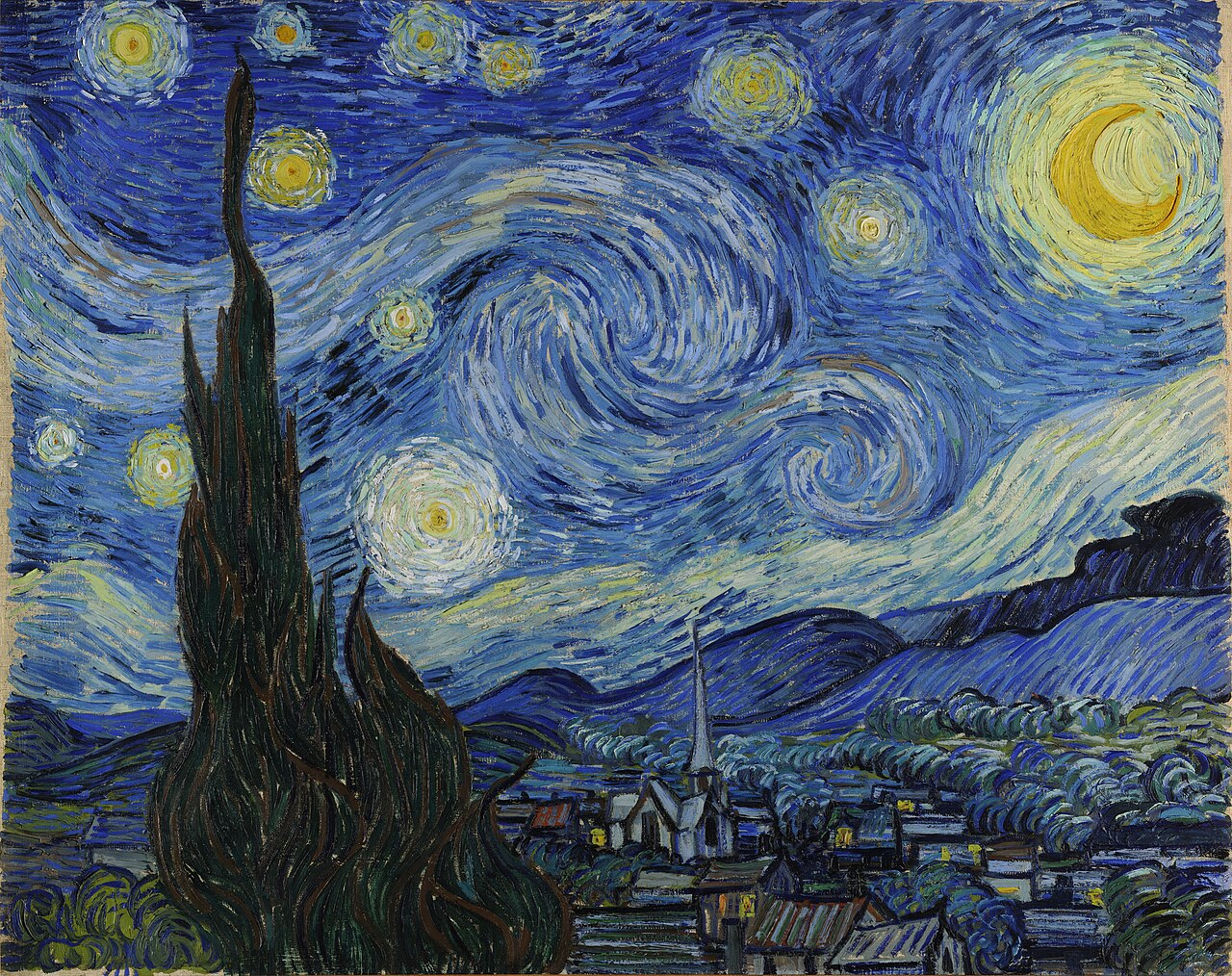
La Nuit étoilée The Starry Night Die Sternennacht
Vincent van Gogh · 1889 · MoMA, New York Vincent van Gogh · 1889 · MoMA, New York Vincent van Gogh · 1889 · MoMA, New York
Lire le texte
On est en juin 1889. Van Gogh vient de s'interner volontairement à l'asile Saint-Paul-de-Mausole, près de Saint-Rémy-de-Provence, après la crise où il s'est mutilé l'oreille. Ce tableau, il ne le peint pas en extérieur devant le motif, comme il le fait d'habitude, il le peint de mémoire et d'imagination, en partie depuis la fenêtre grillagée de sa chambre, en partie depuis des souvenirs qui remontent de son enfance aux Pays-Bas.
Regardez la composition : le ciel occupe presque les deux tiers de la toile, ce qui est déjà un choix radical. Et ce ciel n'est pas calme. Des volutes tournent autour de la lune et des étoiles comme des tourbillons d'eau. Dans ses lettres à son frère Theo, Van Gogh explique qu'il veut peindre non pas ce qu'il voit, mais ce qu'il ressent en regardant la nuit, une agitation, une force presque cosmique. Ce qui est fascinant, c'est que des scientifiques se sont amusés, bien plus tard, à comparer mathématiquement ces tourbillons aux modèles physiques de la turbulence des fluides. Coïncidence troublante ou intuition géniale d'un œil habitué à observer intensément le mouvement, les deux explications se défendent.
Le cyprès sombre, au premier plan, n'est pas anodin non plus. En Provence, cet arbre pousse traditionnellement dans les cimetières : c'est un symbole de deuil depuis l'Antiquité. Van Gogh en fait une flamme noire qui relie littéralement la terre au ciel, comme un trait d'union entre le monde des vivants et quelque chose de plus grand. Quant au petit village en bas, avec son clocher pointu, ce n'est pas un village provençal, c'est une architecture typiquement néerlandaise. Van Gogh peint la Provence avec la mémoire de la Hollande.
Le plus émouvant, peut-être : ce tableau n'exprime pas seulement l'angoisse qu'on lui prête souvent. Dans ses lettres de cette période, Van Gogh parle de chercher une forme de foi dans l'éternité de la nature, les étoiles comme une consolation, pas seulement comme un vertige. Il vendra un seul tableau de son vivant. Celui-ci ne trouvera son public, immense, qu'après sa mort.
It's June 1889. Van Gogh has just voluntarily admitted himself to the Saint-Paul-de-Mausole asylum, near Saint-Rémy-de-Provence, after the crisis in which he cut off part of his ear. This painting wasn't made outdoors in front of the actual scene, as he usually worked, he painted it from memory and imagination, partly from the barred window of his room, partly from memories going back to his childhood in the Netherlands.
Look at the composition: the sky takes up almost two-thirds of the canvas, already a radical choice. And this sky is anything but calm. Swirls twist around the moon and stars like eddies of water. In his letters to his brother Theo, Van Gogh explains that he wants to paint not what he sees, but what he feels while looking at the night, an agitation, an almost cosmic force. What's fascinating is that scientists, much later, had fun mathematically comparing these swirls to physical models of fluid turbulence. A troubling coincidence, or the genius intuition of an eye trained to intensely observe movement, both explanations hold up.
The dark cypress in the foreground isn't incidental either. In Provence, this tree traditionally grows in cemeteries: it has been a symbol of mourning since antiquity. Van Gogh turns it into a black flame that literally links earth and sky, like a hyphen between the world of the living and something greater. As for the small village below, with its pointed steeple, that's not a Provençal village at all, it's typically Dutch architecture. Van Gogh paints Provence with the memory of Holland.
Perhaps the most moving part: this painting doesn't only express the anguish often attributed to it. In his letters from this period, Van Gogh speaks of seeking a kind of faith in the eternity of nature, the stars as a consolation, not just as a source of vertigo. He would sell only one painting in his lifetime. This one would only find its immense audience after his death.
Wir schreiben Juni 1889. Van Gogh hat sich gerade freiwillig in die Heilanstalt Saint-Paul-de-Mausole bei Saint-Rémy-de-Provence einweisen lassen, nach der Krise, in der er sich einen Teil seines Ohrs abschnitt. Dieses Bild malt er nicht im Freien vor dem eigentlichen Motiv, wie sonst üblich, er malt es aus dem Gedächtnis und der Vorstellung, teils vom vergitterten Fenster seines Zimmers aus, teils aus Erinnerungen, die bis in seine Kindheit in den Niederlanden zurückreichen.
Betrachten Sie die Komposition: Der Himmel nimmt fast zwei Drittel der Leinwand ein, bereits eine radikale Entscheidung. Und dieser Himmel ist keineswegs ruhig. Wirbel drehen sich um Mond und Sterne wie Strudel im Wasser. In seinen Briefen an seinen Bruder Theo erklärt Van Gogh, dass er nicht malen wolle, was er sieht, sondern was er empfindet, wenn er die Nacht betrachtet, eine Unruhe, eine fast kosmische Kraft. Faszinierend ist, dass Wissenschaftler viel später aus Spaß diese Wirbel mathematisch mit physikalischen Modellen der Fluidturbulenz verglichen haben. Ein verblüffender Zufall oder die geniale Intuition eines Auges, das darauf trainiert war, Bewegung intensiv zu beobachten, beide Erklärungen sind plausibel.
Auch die dunkle Zypresse im Vordergrund ist kein Zufall. In der Provence wächst dieser Baum traditionell auf Friedhöfen: Er ist seit der Antike ein Symbol der Trauer. Van Gogh macht daraus eine schwarze Flamme, die buchstäblich Erde und Himmel verbindet, wie ein Bindestrich zwischen der Welt der Lebenden und etwas Größerem. Und das kleine Dorf unten, mit seinem spitzen Kirchturm, ist gar kein provenzalisches Dorf, es ist typisch niederländische Architektur. Van Gogh malt die Provence mit der Erinnerung an Holland.
Das Bewegendste vielleicht: Dieses Bild drückt nicht nur die Angst aus, die man ihm oft zuschreibt. In seinen Briefen aus dieser Zeit spricht Van Gogh davon, eine Art Glauben an die Ewigkeit der Natur zu suchen, die Sterne als Trost, nicht nur als Schwindel. Zu Lebzeiten verkaufte er nur ein einziges Gemälde. Dieses hier sollte sein riesiges Publikum erst nach seinem Tod finden.
 ← Retour au parcours
Terminer ma visite →
← Retour au parcours
Terminer ma visite →