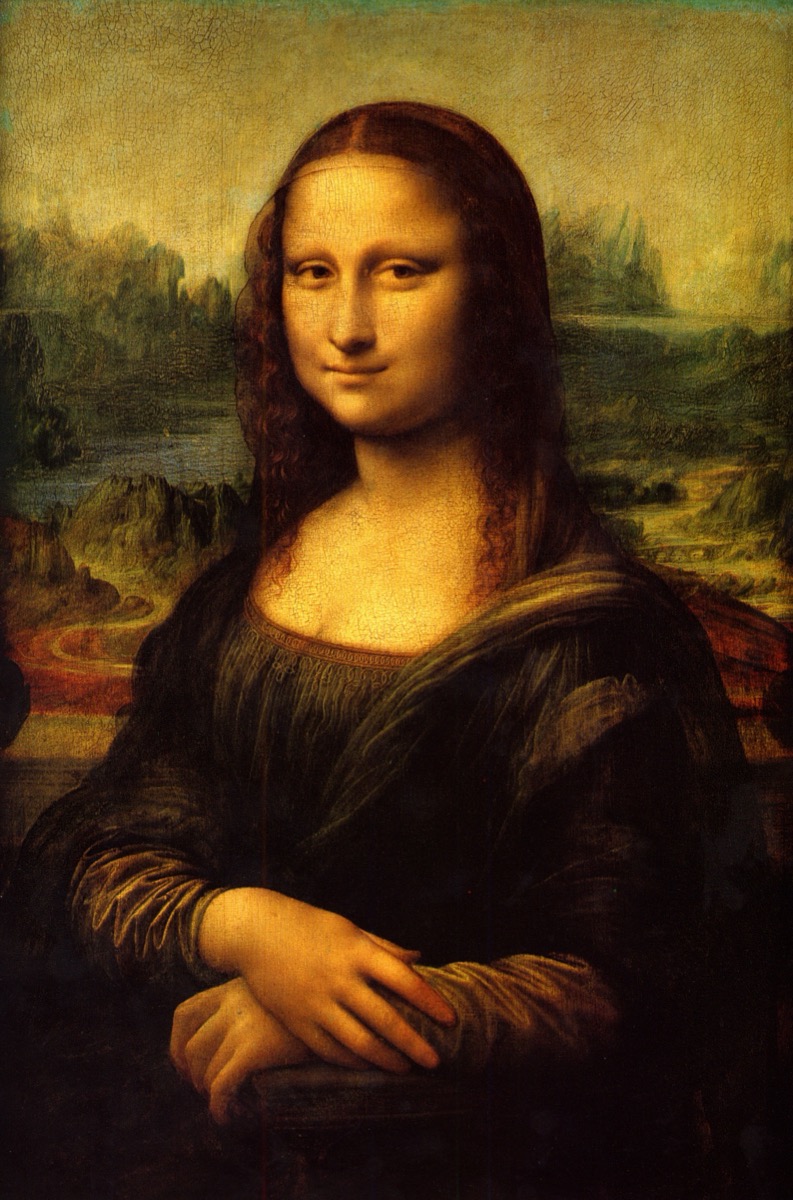
La Joconde The Mona Lisa Die Mona Lisa
Léonard de Vinci · v. 1503–1519 · Musée du Louvre Leonardo da Vinci · c. 1503–1519 · Louvre Museum, Paris Leonardo da Vinci · ca. 1503–1519 · Louvre, Paris
Lire le texte
Ce petit panneau de bois, à peine plus grand qu'une feuille A3, est devenu le tableau le plus regardé de la planète, et honnêtement, ça n'avait rien d'écrit d'avance.
Léonard de Vinci commence ce portrait vers 1503, à Florence. Le modèle serait Lisa Gherardini, épouse d'un marchand de soie du nom de Francesco del Giocondo, d'où le nom italien, la Gioconda. Mais voilà le détail qui change tout : Léonard ne livre jamais le tableau à son commanditaire. Il le garde avec lui, le retouche pendant près de seize ans, le trimballe jusqu'en France où il termine sa vie invité par François Ier. Ce qu'on regarde aujourd'hui, c'est littéralement une œuvre que l'artiste n'a jamais considérée comme finie.
Techniquement, c'est une leçon à elle seule. Léonard invente ou perfectionne le sfumato : au lieu de tracer des contours nets, il superpose des dizaines de voiles de peinture presque transparents, si fins que l'œil n'arrive jamais à localiser précisément où finit la lèvre et où commence l'ombre. C'est exactement pour ça que le sourire semble bouger selon l'endroit où vous regardez sur le visage, regardez les yeux, le sourire s'efface un peu ; regardez la bouche, il revient. Ce n'est pas une légende, c'est de l'optique pure.
Et puis il y a le paysage derrière elle : des montagnes, des rivières, des chemins qui ne se rejoignent pas vraiment, une géographie impossible. Léonard, passionné de géologie et d'anatomie, construit un arrière-plan presque irréel, comme s'il reliait le corps humain à un temps géologique bien plus vaste. Le portrait individuel devient une réflexion sur la place de l'humain dans la nature, très dans l'esprit de la pensée de la Renaissance.
Comment ce tableau discret devient-il LE tableau ? En grande partie grâce à un vol. En 1911, un ouvrier italien du Louvre le décroche et le cache sous son manteau. Pendant deux ans, l'œuvre disparaît, et la presse du monde entier en parle en boucle. Quand elle est retrouvée, la Joconde n'est plus un tableau parmi d'autres : c'est une star. La rareté et le scandale ont fait le reste.
This small wooden panel, barely bigger than a sheet of A3 paper, has become the most looked-at painting on the planet, and honestly, that was never a given.
Leonardo da Vinci began this portrait around 1503, in Florence. The sitter is believed to be Lisa Gherardini, the wife of a silk merchant named Francesco del Giocondo, hence the Italian name, la Gioconda. But here's the detail that changes everything: Leonardo never delivered the painting to the man who commissioned it. He kept it with him, reworking it for almost sixteen years, carrying it all the way to France, where he ended his life as a guest of King Francis I. What we're looking at today is, quite literally, a work the artist never considered finished.
Technically, it's a masterclass on its own. Leonardo invented, or perfected, the sfumato technique: instead of drawing sharp outlines, he layered dozens of almost transparent veils of paint, so fine that the eye can never quite pinpoint where the lip ends and the shadow begins. That's exactly why the smile seems to shift depending on where you look on the face, look at the eyes, and the smile fades a little; look at the mouth, and it comes back. That's not a myth, that's pure optics.
And then there's the landscape behind her: mountains, rivers, paths that don't quite connect, an impossible geography. Leonardo, who was passionate about geology and anatomy, built an almost unreal background, as if he were linking the human body to a much vaster geological time. The individual portrait becomes a reflection on humanity's place in nature, very much in the spirit of Renaissance thinking.
So how did this quiet painting become THE painting? Largely thanks to a theft. In 1911, an Italian handyman working at the Louvre took it off the wall and hid it under his coat. For two years, the work vanished, and the press across the world talked about nothing else. When it was found again, the Mona Lisa was no longer just another painting: it was a star. Rarity and scandal did the rest.
Diese kleine Holztafel, kaum größer als ein Blatt A3, ist zum meistbetrachteten Gemälde der Welt geworden, und ehrlich gesagt war das keineswegs vorherbestimmt.
Leonardo da Vinci begann dieses Porträt um 1503 in Florenz. Als Modell gilt Lisa Gherardini, die Ehefrau eines Seidenhändlers namens Francesco del Giocondo, daher der italienische Name la Gioconda. Doch hier kommt das Detail, das alles verändert: Leonardo lieferte das Gemälde nie an seinen Auftraggeber. Er behielt es bei sich, überarbeitete es fast sechzehn Jahre lang und nahm es mit nach Frankreich, wo er sein Leben als Gast von König Franz I. beendete. Was wir heute betrachten, ist buchstäblich ein Werk, das der Künstler selbst nie als vollendet ansah.
Technisch gesehen ist es eine Lehrstunde für sich. Leonardo erfand, oder vervollkommnete, das Sfumato: Statt scharfe Konturen zu zeichnen, legte er Dutzende fast durchsichtiger Farbschleier übereinander, so fein, dass das Auge nie genau erkennen kann, wo die Lippe endet und der Schatten beginnt. Genau deshalb scheint das Lächeln sich zu verändern, je nachdem, wohin man im Gesicht schaut, blickt man auf die Augen, verschwindet das Lächeln fast; blickt man auf den Mund, kehrt es zurück. Das ist keine Legende, das ist reine Optik.
Und dann ist da die Landschaft hinter ihr: Berge, Flüsse, Wege, die nicht wirklich zusammenpassen, eine unmögliche Geografie. Leonardo, der sich leidenschaftlich für Geologie und Anatomie interessierte, schuf einen fast unwirklichen Hintergrund, als würde er den menschlichen Körper mit einer weit größeren geologischen Zeitspanne verbinden. Aus dem individuellen Porträt wird eine Reflexion über den Platz des Menschen in der Natur, ganz im Geiste des Renaissance-Denkens.
Wie wurde aus diesem unauffälligen Gemälde DAS Gemälde? Vor allem dank eines Diebstahls. 1911 nahm ein italienischer Handwerker, der im Louvre arbeitete, das Bild von der Wand und versteckte es unter seinem Mantel. Zwei Jahre lang blieb das Werk verschwunden, und die Presse der ganzen Welt sprach über nichts anderes. Als es wiedergefunden wurde, war die Mona Lisa kein Gemälde mehr wie jedes andere: Sie war ein Star. Seltenheit und Skandal erledigten den Rest.
 ← Retour au parcours
Terminer ma visite →
← Retour au parcours
Terminer ma visite →